







Eager to get an early start to my first day on the island, I jogged from customs to the rental car kiosks. Waiting for the attendant to finish a call, I could see my name and reservation number alone on a dot matrix printout near her keyboard and envisioned myself cruising along legendary shorelines to pristine beaches in my Corolla Or Equivalent. By the time she hung up, I could already feel my toes in the sand.
“We do have your confirmed reservation, sir, but I’m sorry we do not have any cars for you.”
“Then why did your system allow me to make a reservation?” I asked.
“That’s just how it has happened sometimes lately. Things have been odd. I’m so very sorry, sir.”
After nearly two full years of a complete pandemic lockdown that had devastated its tourism-based economy and returned thousands of its hospitality professionals back to fishing, farming or both, Fiji had just reopened to visitors a couple of weeks before my arrival, and I appreciated both her sincerity and the apparent fact that one of millions of effects of global supply discombobulation was that my car wasn’t here, even though I’d been assured that it would be here. I wasn’t upset, but I was also determined to get my itinerary underway in some way that didn’t rely primarily on taxis, my thumb, or my feet.
“I understand that things are messed up these days,” I assured her. “And yet there must be some car, somewhere within your inventory, that I can use for just one day, and then tomorrow we’ll see if there’s anything else available. Maybe?”
“Hmm. Well, I…Please wait here, sir” she said, and disappeared. Returning a few minutes later with a young man in grease-smeared coveralls, she hesitated and proposed that if I was open to the idea of “unconventional” transportation, her colleague would show me an option.
If you’re not from Asia or a still-inhabited medieval village, you may not be familiar with the Suzuki Carry utility truck, the patron saint of deliverymen everywhere that arm-span-width roads are considered roads.
“We use this for parts and service when our other cars break,” he explained. “Not as nice as our other cars, but strong. And does not break. A good truck.”
Having only my backpack, I was unconcerned by the ultrasupersubcompact size (3 x 1.4 x 1.8 meters) of this 1998 edition, and I wasn’t trying to impress anyone with intact upholstery. And although shifting with my left hand due to the cab’s Imperial configuration would require some adjustment as I’d try to coax all forty, formidable horses out of the engine, it was, I concluded, preferable to immobility.
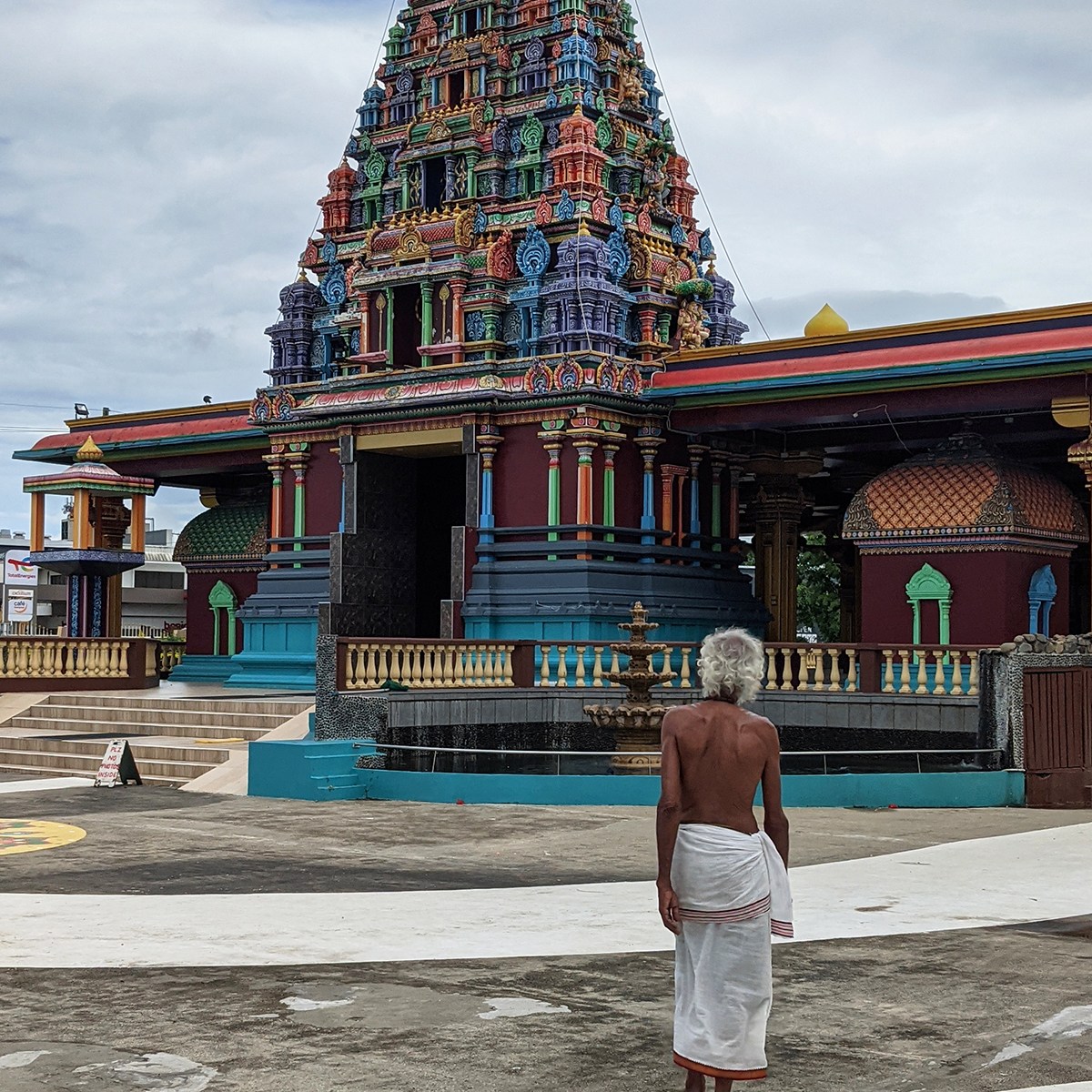
Paperwork completed and keys in ignition, I headed into Nadi where I reviewed my notes and map over the delicious and absurdly inexpensive vegetarian fare at Saravana Bhavan on the Sri Siva Subramaniya Temple compound. Wanting to take advantage of 4WD (driven, if I’m getting the tricky math right, by some ten hp per wheel), I chose to forgo seaside asphalt in favor of elevated dirt, and the “Highland” in Nausori Highland Road stirred my imagination.
INTO THE NAUSORI HIGHLAND
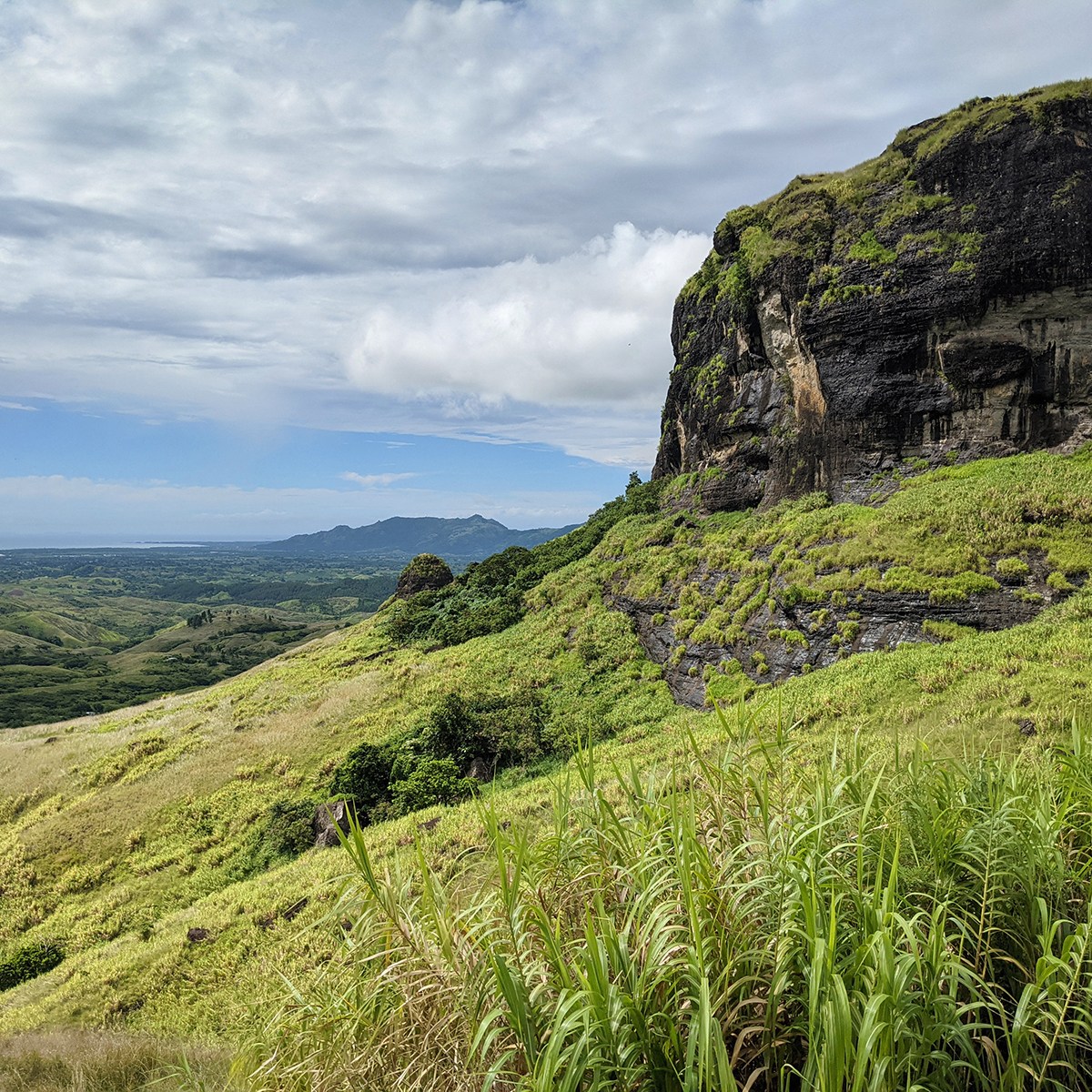
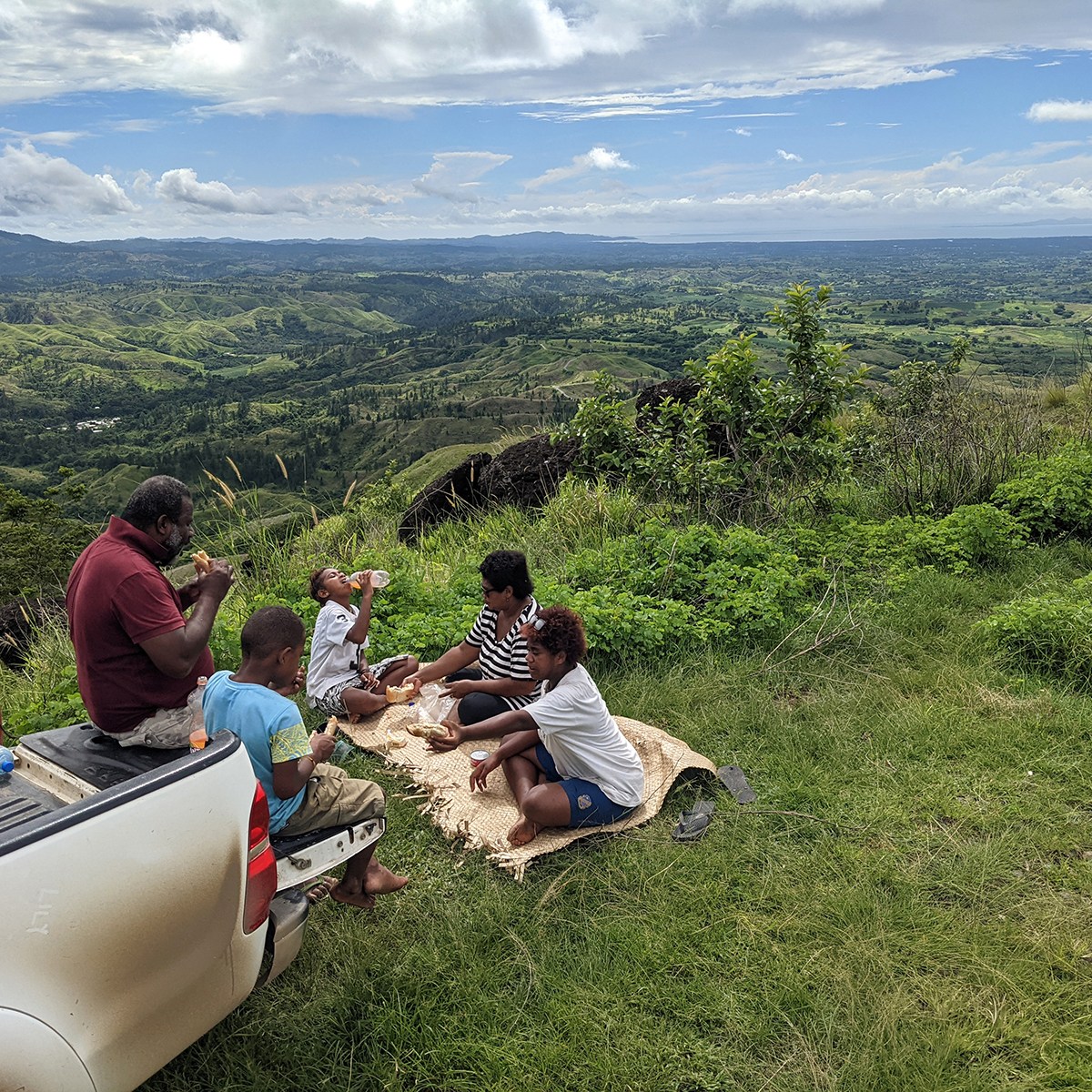
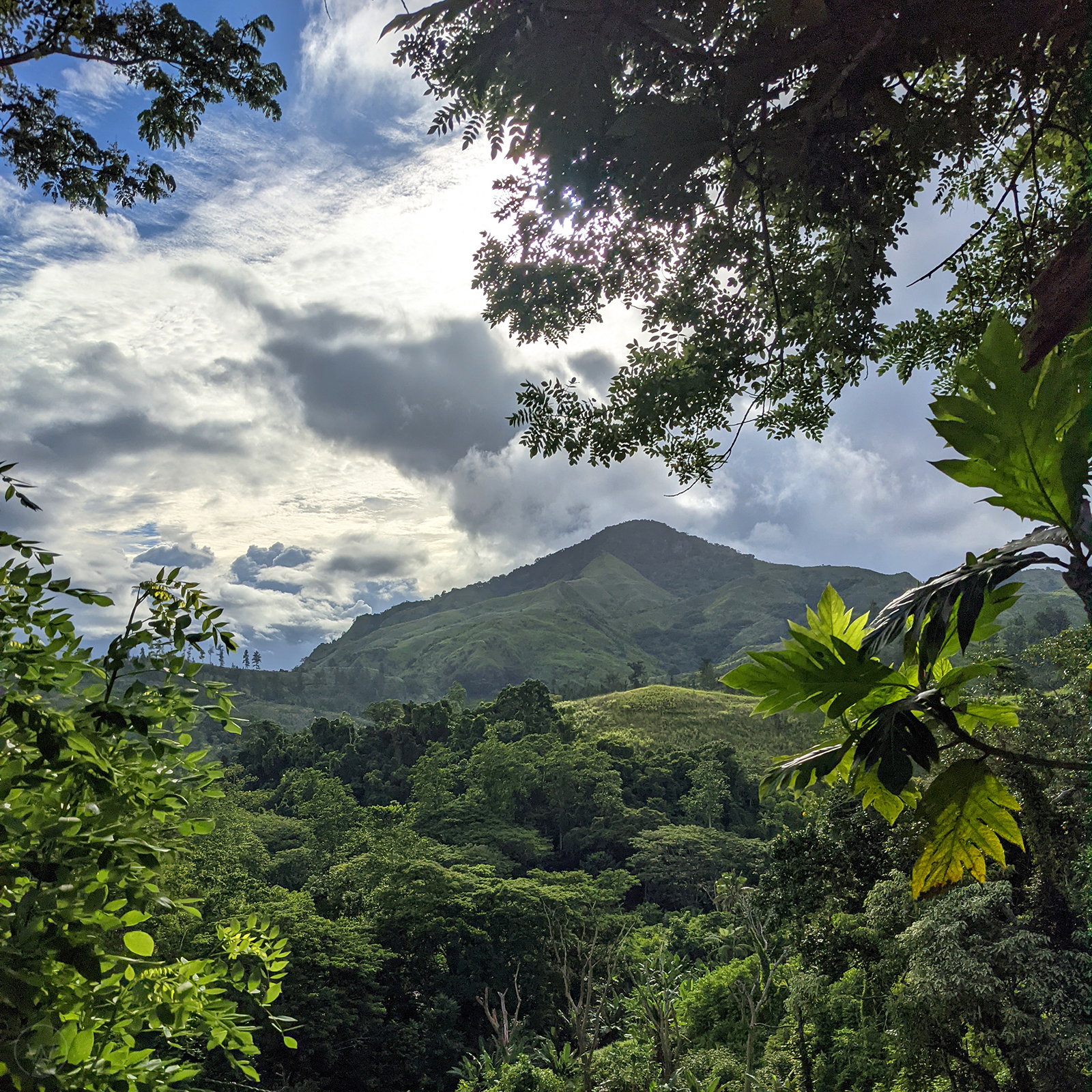
Wending its way eastward at sea level through small farms and villages, passing the occasional mosque, cemetery or minimart, it didn’t take long for the asphalt to yield to dirt. Once buildings had fully yielded to trees, the incline increased and I soon found myself at the first scenic pullout, near Heavens Peak, an escarpment maybe 200 meters above sea level from which I shared sweeping views of Nadi Bay with a family picnicking from the back of their truck. Perhaps in a gesture of compassion prompted by a quick comparison between their burly Tacoma and my petite putt-putt, they also asked that I share their loaf of bread, a generous invitation that I didn’t hesitate to accept.
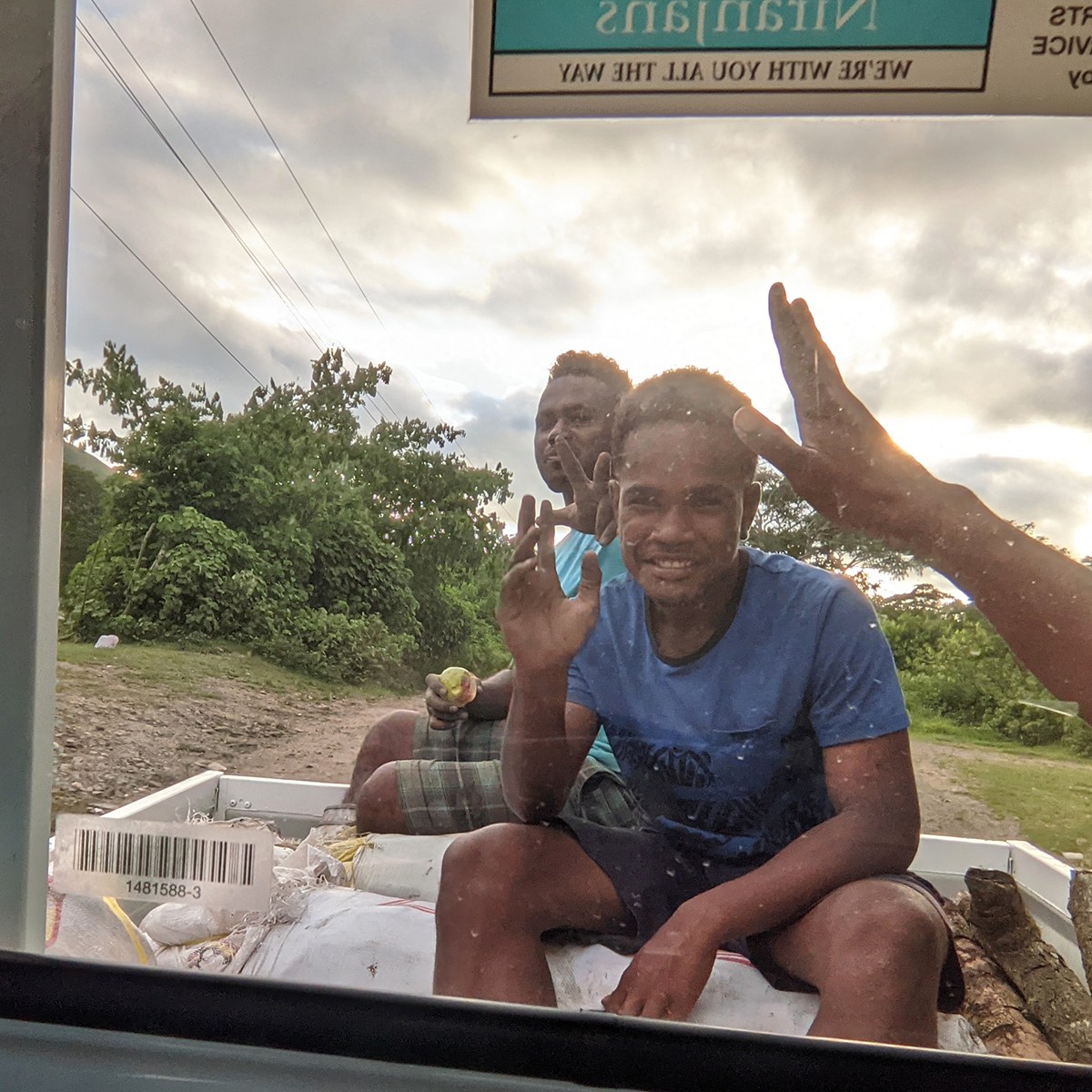
Warmed and culturally emboldened by this exchange, as I continued upward and eastward I began to gesture to those walking roadside in my direction to hop in the back. Several responded with wide smiles and, together with whatever load they had in their arms, jumped eagerly into the bed of the truck, then after relatively short distances tapping on the cab window or roof to signal their end station, although few of these had any landmarks (such as a building or a path forking from the road) that I could discern in the dense jungle.
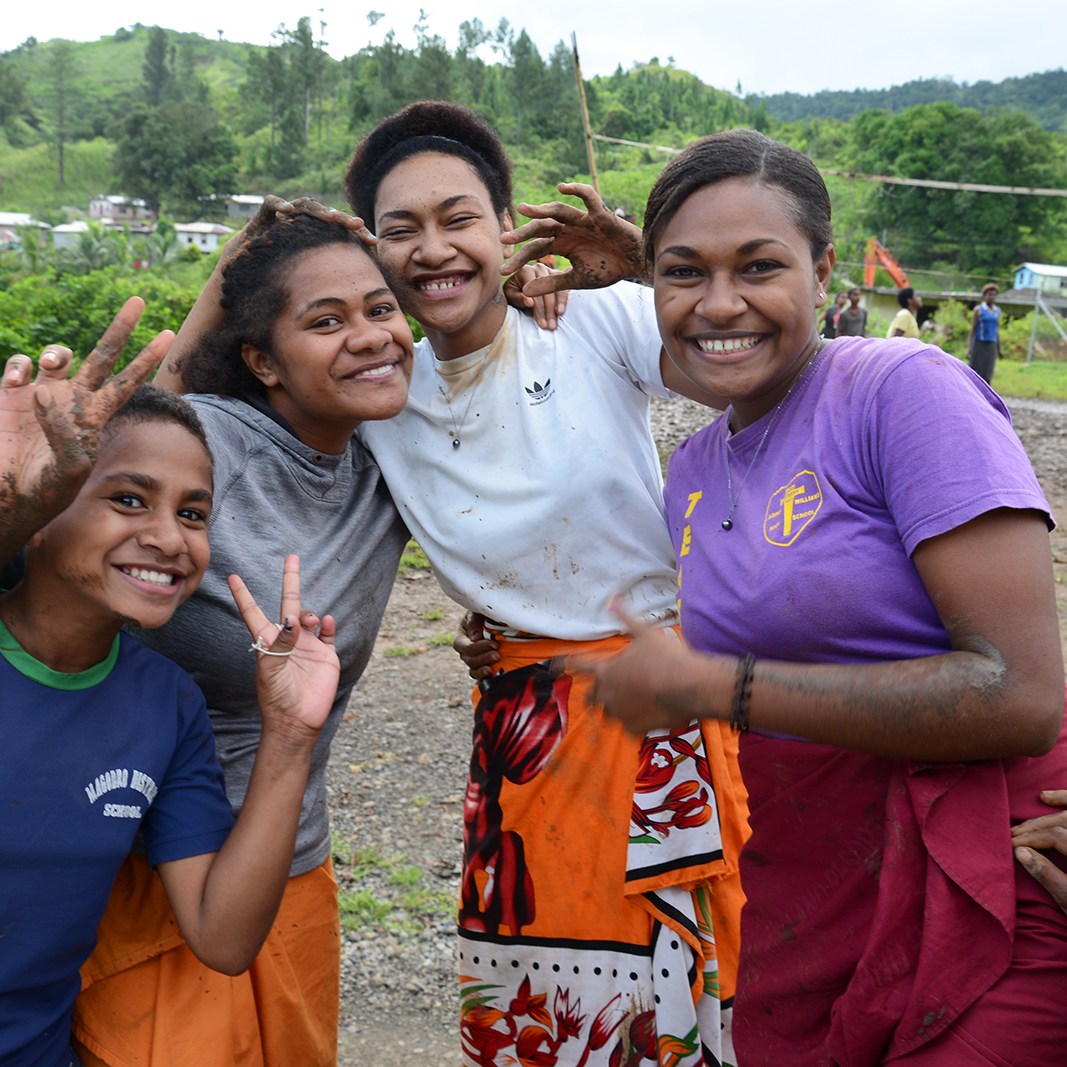
Turning south at Bukuya, I didn’t make the hike to the village’s “secret” waterfall but did stop to watch a spirited match of volleyball near the school. I might have accepted the kids’ merry invitation to join, but my passengers for that stretch, a mother and young son toting large bags filled with a fresh harvest, were eager to continue their journey south to Tuvu, where I dropped them off at the Valley Shopping Centre, rural Fiji’s charming answer to the suburban strip mall.
HAULING THE HARVEST
Now at about the position of three on the clock of my loop, I was heading southwest next to the winding Sigatoka River that empties into the sea at the city of the same name. Here, as at the beginning of my drive east of Nadi, the jungle gave way to small, neatly cultivated fields on either side of the road. Nearing Savasava Creek, I came upon a young man with a white nylon bag the size of a small dishwasher on his shoulder. At the rumble of my approaching wheels, he looked up and, beholding the vastness of my rig’s bed, raised his thumb. Seizing this moment of obvious destiny for which The Little Carry That Could had been waiting all of its twenty-plus years, I pulled over and attempted a squinted-eyes-and-clenched-jaw expression of manly understanding as he hoisted his bushel of corn into the back. But rather than hop in, he paused, looked at me with a hopeful grin, and let out a piercing whistle with his fingers. In any number of other settings, this might have made me nervous, but the trust I already felt among these people prevailed. And so I waited while over the course of the next couple of minutes, one by one, five guys emerged from the tall roadside brush, each carrying his own bushel. I nodded them to the back.
Three of them settled on and among their bounty, while two headed back to the fields. English is one of Fiji’s three official languages (the other two being Fijian and Hindi), but is not emphasized in the mountainous areas far from the tourist trade routes. Correctly assuming a lack of Fijian proficiency on my part, the first guy – whose name I’d soon learn was Noah – used his index finger in the universal whirlibird gesture meaning “turn around,” punctuated with an air-tapping point (“go that way”), accompanied by the same hopeful grin. Not knowing where this would lead, other than “that way,” I spun us around and headed back upstream.
About ten minutes later, as we entered the village of Toga, Noah tapped on the window and pointed me down a long side road, at the end of which we backed into a muddy drive between two homes and unloaded the corn. No sooner had I shaken hands with everyone and set one foot into the cab than an older man, bare-chested and bare-pated with white stubble on his jaw, emerged from one of the homes and gestured to me to wait. After a brief exchange with Noah and the others, he stepped toward me and, pointing to the open door behind him, said, “Kava.”
I’d seen the word “kava” in my pre-trip readings and had a vague understanding that it was a traditional drink reserved for special occasions. So I recognized that this was an invitation of honor extended out of gratitude for transporting the day’s heavy harvest, but because we were still in the pandemic, albeit at the apparent tail-end, I was concerned. I’d had COVID at least once and more shots than I can count, so I felt bulletproof. My concern, rather, was for my hosts, as images from the ignominious history of colonizers and their city-bred pestilences flashed across my windshield.
“Thank you, no,” I said, furrowing my brow and tilting my head apologetically.
“Kava,” he nodded gently.
More images of indigenous peoples succumbing to smallpox, measles and yellow fever.
“So sorry, I must go,” I said with a slight bow and palms pressed together.
He shrugged with resignation and directed Noah to give me a guava. I stepped toward Noah to accept this gift, saying “thank you” with exaggerated lip stretching that I assumed would facilitate translation and emphasize sincerity. Turning back toward the truck and opening the door, over my shoulder I heard a quiet yet firm, “Kava. Come, kava.”
So I went.
KAVA CEREMONY
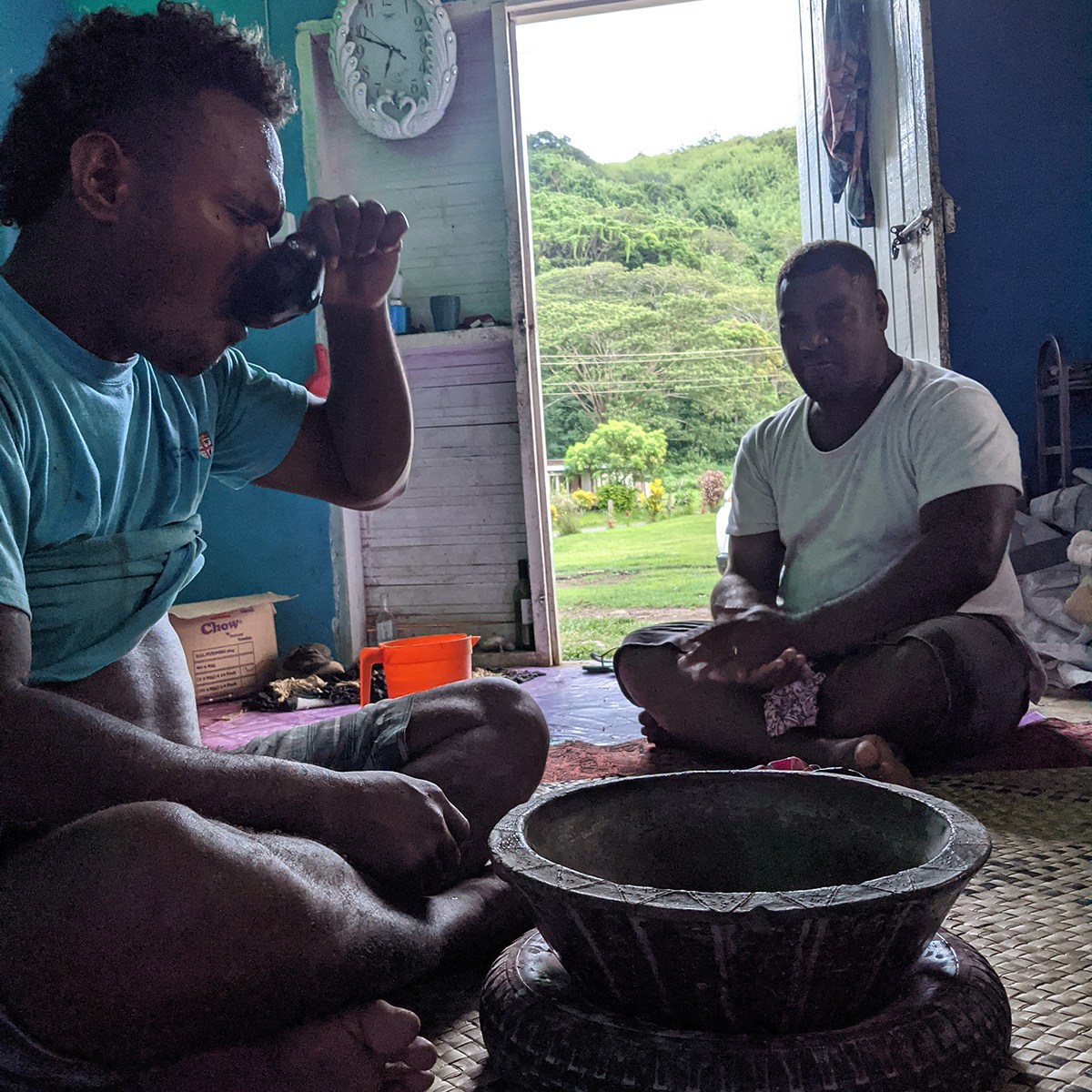
The home was maybe eight by ten meters, with three rooms I could see and probably a couple more tucked away in the back. We left our shoes at the door and Noah spread an ibe (the woven mat typical of these islands, usually exchanged as a gift at weddings, funerals and other such occasions) on the floor of the main room. Once seated on the mat, I was better able to appreciate the intricacy of its design, which, combined with the twinkling glow of strung lights – and a plastic Christmas tree – that lingered from the recent holiday, as well as the walls’ cheery robin’s egg blue plus a clock gone missing from Liberace’s personal collection, set a dreamlike stage for what was to come.
A woman in her sixties stirred from a pile of pillows in the room’s far corner, sat up and introduced herself and her family members in English. She was Mere, aunt of the young man I now knew as Noah, and the gentleman was Isaac, her husband. She was a retired nurse who had been reactivated during the pandemic to provide vaccinations at small, ad hoc stations established throughout the country’s remote villages, news that assuaged my concerns about my plague-bearing droplets. While Mere told me of how the island had endured the pandemic, Noah left and returned moments later with his cousin Tom, Mere and Isaac’s son, who had also been in the truck. They carried a pitcher of water, a tanoa (a carved wooden bowl the size of a large salad bowl), two halves of a coconut shell, an ornate burgundy cloth, and what appeared to be a heavy-duty wheelbarrow tire painted red.
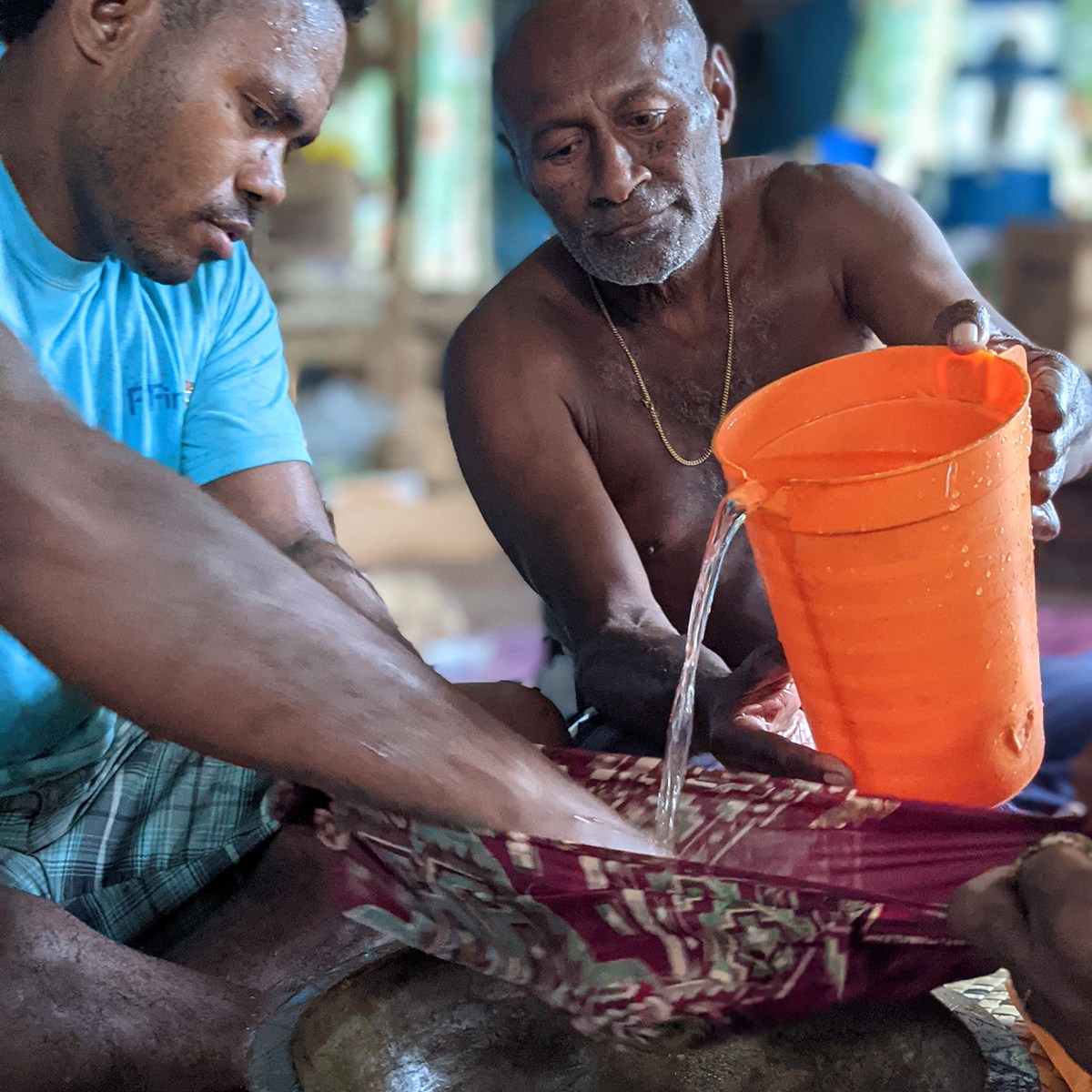
With a procedural reverence that I think was real and not an imagined product of my jet-lagged disorientation, the three men assembled these wares, first laying the tire on the ground and placing the tanoa in its donut hole, then stretching the cloth over the bowl. Tom then produced a small paper sack and poured a fist-sized pile of ivory-colored powder on the center of where the suspended cloth. He and Noah, sitting on opposite sides of this little beverage altar, lifted the cloth and pulled it taught as Isaac poured water over the powder, which caused a paste to form in the circular dimple around the pile. Transferring his grip of the cloth to one hand, Noah began to stir and knead with his other, and once the mixture had taken on a squishy, clay-like quality, he began to press it downward. Isaac continued to pour intermittently and the tanoa filled with the brownish-grayish drink that Fijians also call yaquona or, somewhat more onomatopoeically, grog.
Noah dipped one of the coconut shells into the murky pool and raised it to chest level, then filled the other and passed it to me. Mimicking him, I held my shell in the cup formed by my hands, looked at each of the three men and then at Mere, who smiled back from her perch on the pillows. As they offered an almost choreographed nod of encouragement, I sipped from the shell, upon which, on Noah’s cue, the men clapped twice and said a few words in Fijian. (Although I didn’t know at the time that the word “kava” means “bitter” in several Polynesian tongues, my own tongue’s experience now makes me wonder which came first: the concept of bitterness or this drink?) Tom gestured for Noah’s empty shell, which was refilled and handed to Isaac. Isaac drank, I sipped, they clapped, they spoke as I gave my best phonetic shot at joining them, then the sequence repeated, the family shell going to Tom this time.
Finding my shell now empty, and all three men having had their drinks – I learned later that Fijian women do participate in the kava ritual, but not as often as men – I thought we were done. Turned out this was just Round One, as Noah again dipped both shells and we repeated the entire process at least five times, each with slightly more relaxed adherence to protocol than before, until there was too little grog left to scoop from the tanoa. With the exception of the claps and the repeated words, all of this was done in silence, which Mere finally broke when she approached and asked me, “Do you feel anything?” “Yes,” I responded. “Well, uh, no…I don’t feel my mouth!” She released a joyously toothy smile and translated this through her giggles to the men, who, already on the floor, nearly roll-laughed for a moment while Isaac slyly slid a piece of hard candy across the mat to me. He pointed with playful sternness to my mouth as Mere explained that this candy is used to counteract the mildly narcotic effects of the yaqona shrub’s dried and crushed root.
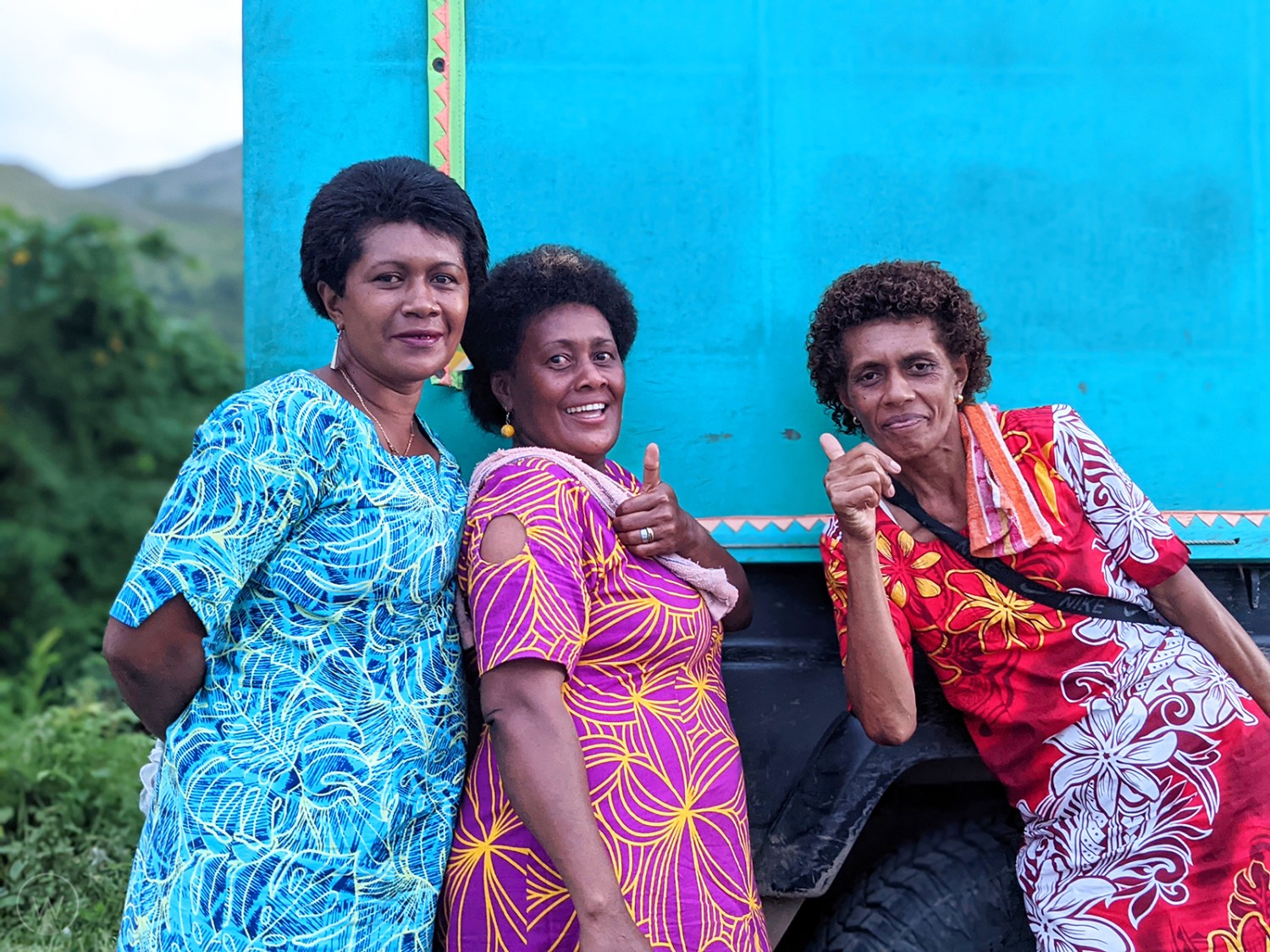
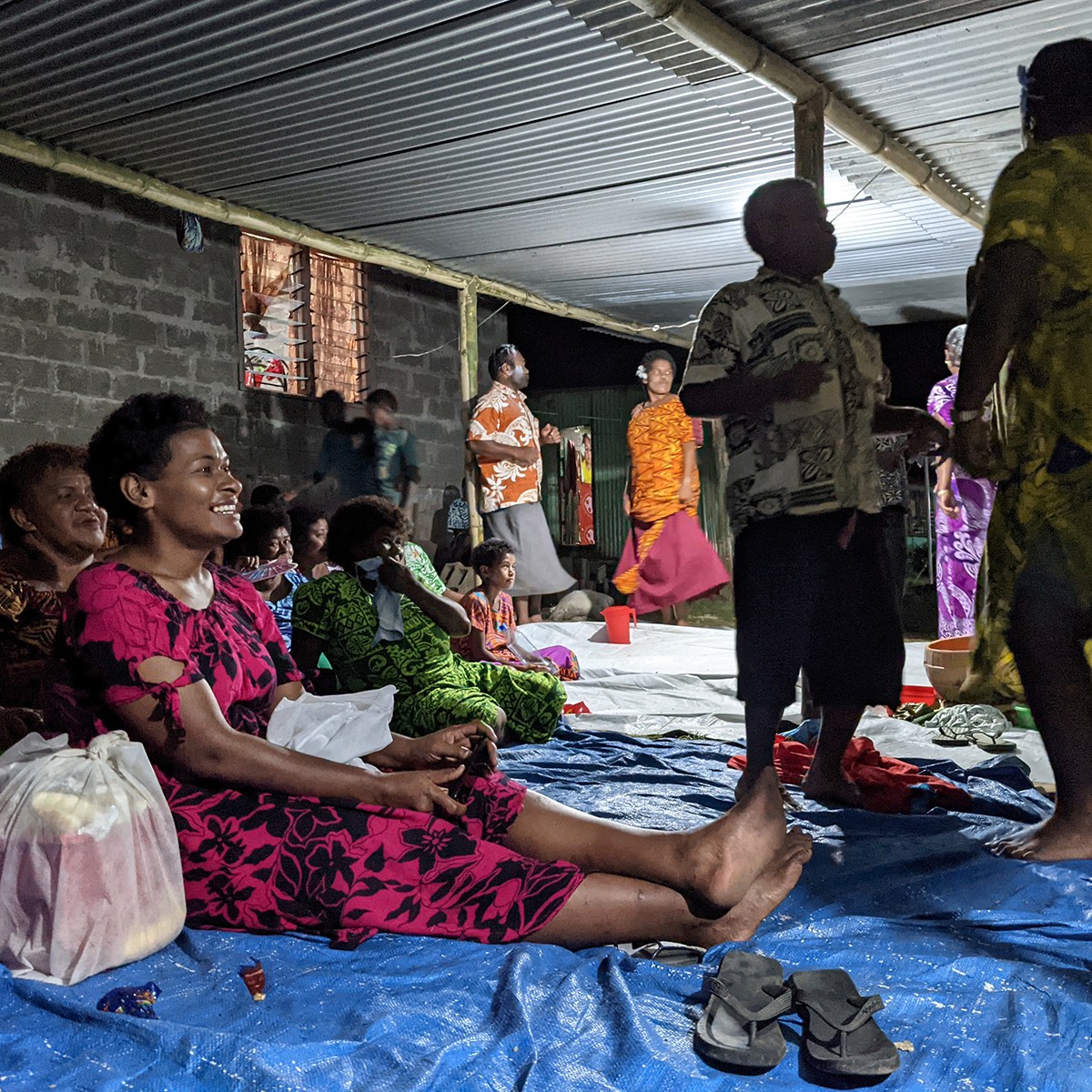
What I did feel was a strangely comforting sense of kinship with my hosts, their warmth enveloping this stranger in a blanket of guileless hospitality. More than an hour after I had first stopped to pick up Noah, I thanked his family, smiling and waving at the door of their home, and continued my drive. Pointing the wheels due south after a wide bend, I began to see at a distance little bursts of bright colors popping against the green backdrop that lined the dirt road ahead. As I neared the outskirts of the village of Mavua, these brilliant clusters grew tighter and I realized they were people walking toward the town, their dress much more vibrant than what I’d seen to this point. Lining the west side of the road, opposite the river that flowed through town, was a contiguous series of tents and shelters of corrugated metal supported by bamboo posts about three meters tall, under which sat alternating groups of men and women on tarps and sheets spread across the grass, the men for the most part circling tanoas, the women arrayed more casually.
A VILLAGE WEDDING
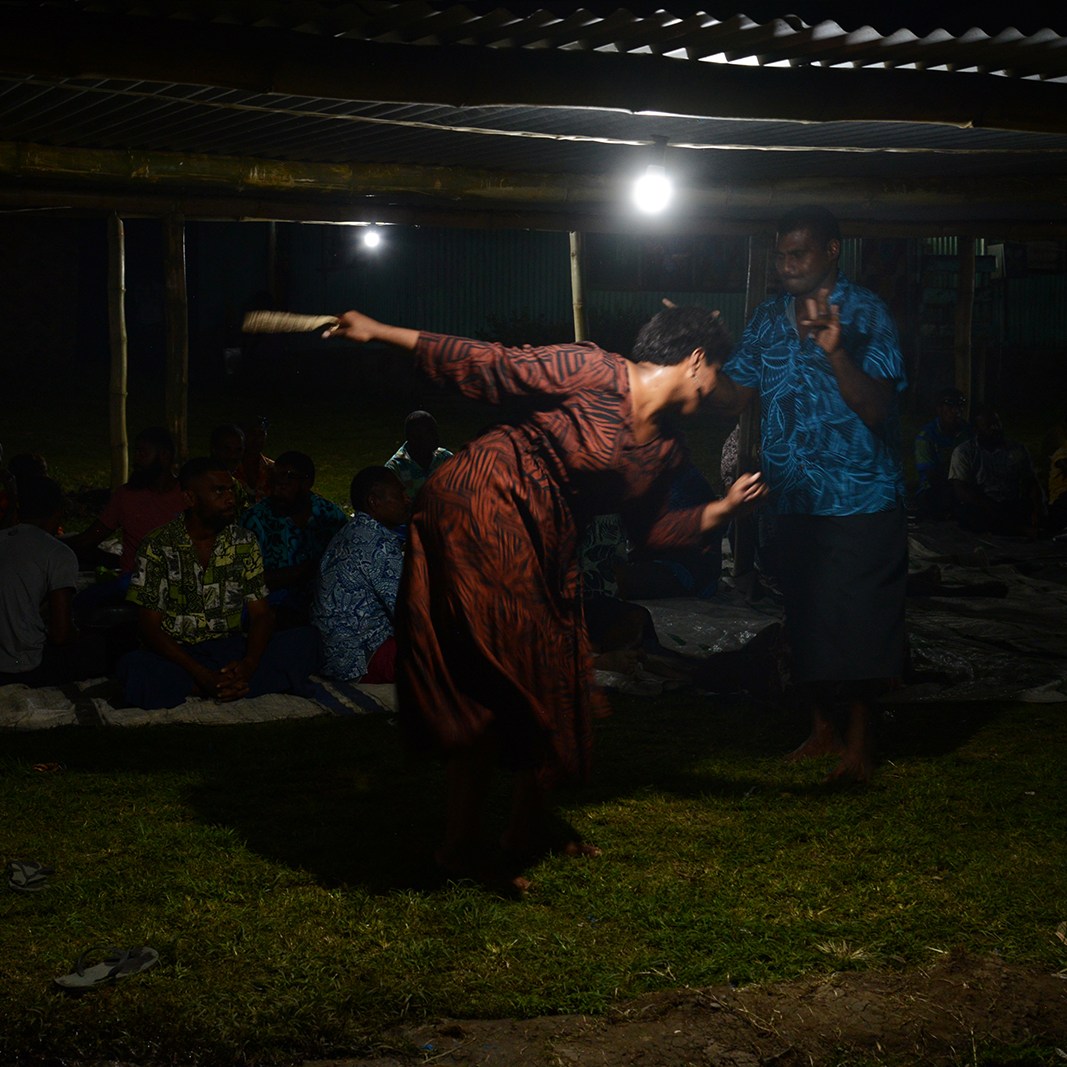
I pulled over and asked a group of teenagers what was happening and was told, with giddy enthusiasm, that it was a wedding. With several of them trailing me, as they’d continue to do for more or less the duration of my stay, I parked at the south end of the festival grounds, where a band consisting of two guitarists and a singer-keyboardist gave it their full-throated best. Even without watching the guests continue to stream in from all directions, I could have surmised that it was early in the evening because I was initially transported back to the awkward stupor of middle-school dances where the music far surpassed the motion. This changed once the headcount apparently reached critical mass, and a few measures into each song, some of the men would rise from their places and walk toward the ladies, a woman here or there rising as her eyes met a man’s, while others waited until the man reached her and extended a hand. After each dance, all would return to where they’d been seated and await the next song. Also like middle school, some songs would pack the dancefloor, while others would coax only a few, determined couples from their repose. Minimal participation was intended in the case of the pas de deux designated for the bride and groom, which to my uninformed eyes seemed to follow a series of prescribed gestures and steps and whose conclusion elicited raucous approval from all.
Snickering as if they’d placed bets on the outcome, my self-appointed chaperones encouraged me to join the others. Lani, their primary spokeswoman, and I agreed that being younger than my daughter, she might not be the best partner for my crash-course in Fijian dance. And so I approached the nearest group of seated women and offered a “dunno what I’m doin’, but here goes” smile and my hand in their general direction. One accepted, so I kicked off my sandals and we boogied on a patch of ground we staked out among the crowd. After thanking and escorting her with exaggerated gallantry back to her teasing friends, even as the night air pulsed with the rhythm of laughter and song, my exhilaration turned to an uncomfortable awareness that despite the jolly graciousness of all those around me, I was intruding on something very special, even sacred – an actual wedding crasher. Suddenly sobered at this thought, I put my sandals back on, packed up my camera and headed toward the truck. I’d gone about a dozen paces when I felt a tap on my shoulder and turned to find the big, expectant smile of a diminutive septuagenarian. Without a word, this miniature matriarch took my hand and guided me back out to the dance floor with its canopy of corrugated steel and gleaming stars.
QUESTIONS FOR READERS
- When has serendipity most surprised you while traveling?
- What’s your favorite drive on Viti Levu?
- What are some memorable local rituals you’ve experienced?
 WANDERLOOSED