


There had been no “vacation” per se for many, many months. Sporadic closures and quarantines and travel bans and local “If You’re From States X, Y or Z, Please Don’t Come Here” lists, coupled with the enticing prospect of torturous on-tarmac nasopharyngeal swabbings, meant that if we were going to squeeze in a jailbreak before school resumed (that is, whatever “school” was to entail), it had to involve driving and it had to happen now.
I’d long been curious about Ouray, Colorado’s “Little Switzerland of America,” just a couple of hours across our state line, and as I looked more closely into the region, it began to dawn on me that it just might offer enough raw material to cobble together a decent little outing. As my research started to amass attraction after attraction along this route, I thought I’d spawned road-tripping brilliance with the thought, “Well hey, why not just follow the route?” only to discover that some clever committee had already discovered this route and dubbed it the San Juan Scenic Skyway.
DAY 0
Just three hours into what was supposed to have been our trip, a marathon (mostly masked and non-contactish) youth karate tournament ensured that we were three hours late getting started on our trip. And so what was supposed to have been a bonus afternoon of leisurely meandering Mesa and Montrose Counties was reduced to seeking food and shelter for the evening.
Food was found at Grand Junction’s two-thumbs-waaay-up 626 on Rood, which served us mixed-modern American fare on a shaded patio. We started with tasty truffle fries (white truffle oil, roasted garlic aioli, Parmesan) and chilled corn elote soup (with tajin, lime and jalapeño), while one of my boys tried a “Just don’t tell your mom” Pop Rocks Cocktail from the extensive Buzzless Libations menu. Entrées included the hazelnut lentil cake (I’ll eat anything with hazelnuts, which in this case also came with roasted beets, crispy arugula & leeks, dried tomato crisps, and spicy mango passion fruit & coriander sauces), a half-pound Colorado Wagyu burger that kept my 6’4” guy busy and happy, and for his younger bros a couple of the best kids’ menu steaks we’ve ever eaten, which is 626’s flatiron served in the portion used on their steak salad. I also met what might be my new favorite NA beer, Paulaner Weißbier-Zitrone Alkoholfrei.
Side Excursions We Skipped
In Palisade (15 minutes from Grand Junction), both the family-owned Sage Creations Organic Farm and SunCrest Orchard Alpaca Farm & Fiber Works seemed charming. Maybe next time.
NIGHT 0
A king bed for three plus an adequately cozy chair-ottoman combo for one were mercifully made available by Dave at the Montrose [motel name withheld in order to protect Dave’s career], who, with the entire town booked and no nearby camping options available, squeezed us into a configuration that may or may not have violated company policy, fire ordinances, etc. Pretty sure he booked my two youngest by weight, not by unit.
DAY 1
Black Canyon of the Gunnison is a relatively new (upgraded from Monument in 1999), small (47 square miles, making it smaller than even tiny Acadia; for context, Yellowstone is 3,741) and infrequently visited National Park. But if you can imagine the scar a colossal Bowie knife would leave when plunged a couple thousand feet through charcoal-gray strata and then dragged drunkenly for more than a dozen miles, you get the basic idea and — except for those with acute acrophobia — the basic allure. A satisfactory visit here that doesn’t involve extensive hiking (for example, between the rim and the river) can last between a couple of hours and half a day, and several spectacular and surprisingly varied vistas can be appreciated without walking more than a few hundred yards.
Our research directed us to the South Rim rather than the North, and we enjoyed several of the short-walk overlooks, including Gunnison Point (from the visitor’s center), Pulpit Rock, Devil’s Lookout (our favorite), Chasm View and Painted Wall View. We also made the trek out to the Park’s highest lookout, Warner Point, which, despite its common description as “easy,” I’d recommend only if you’re in at least fair shape and not pressed for time, and it’s not 95 degrees. We closed our visit with a thirty-minute (r/t) drive down the East Portal Road to the Gunnison River (turn south at the intersection just inside the south entrance station), and although there wasn’t much at the bottom other than a chance to splash in the river near the anglers, the descent was enough of a thrill to warrant the little detour.
A pleasant drive through several small towns and a lot of healthy, green forest — craggy, Dolomite-like peaks moving closer and closer to us on the southern horizon — delivered us to Telluride by mid-afternoon. We explored Main Street aka Colorado Avenue, rode the (coup of municipal planning) free gondola between Telluride Town and Mountain Village, where we enjoyed very good and reasonably priced Hawaiian and chicken-pesto pizzas at Crazy Elk, and even took stabs at both Tomboy Road and the Black Bear switchbacks toward Bridal Veil Falls. We made it a couple of miles and up the former and a couple of yards up the latter before admitting that we needed something with much higher clearance and much knobbier tires. We also conceded that in terms of both topography and charm, Telluride outdoes Park City — this admission coming somewhat begrudgingly due to our Wasatch DNA, but without much debate, although it did come with the evenhanded caveat that, in the name of scientific objectivity, we’d need to “try it during winter in order to make a full assessment.” We’re looking forward to our first winter visit to Telluride.
Side Excursions We Skipped
We’d hoped to rent a Jeep in Ridgway and drive the Last Dollar Road for what are reportedly gobsmacking vistas of the Rockies, but the rental place was out of business. And a few miles en route, the Man Council, collectively eager to get on to Telluride, unanimously voted a U-turn from our planned visit to the Dry Mesa Dinosaur Quarry in Uncompahgre National Forest, asking, perhaps rhetorically, whether even one of world’s biggest Jurassic finds could outdo what we’d already seen at Dinosaur National Monument a couple of years earlier.
NIGHT 1
I’d thought we might overnight at Telluride’s neat-and-tidy Town Park Campground, but it was full, so at dusk we headed on to Ouray. There was a sum total of zero vacancy in Ouray, including at its highly-rated Amphitheater Campground (which sits at 8,400 feet), and so we availed ourselves of a roadside pullout a few turns downhill from the campground, where the constant murmur of what must have been Cascade Falls was interrupted only by the stout overnight wind that whipped up overhead pine branches. And early the next morning, we struck camp in record time before anyone with citation authority could ask any questions. (And, yes, the equivalent of the overnight fee was subsequently donated to the National Forest Foundation. ‘Cause that’s how Wanderloosed rolls, yo.)
DAY 2
It was easy to see why Ouray is dubbed “The Little Switzerland of America.” Sure, it’s not nearly as uniformly verdant, and it has few cows and fewer cowbells, just one language, and no banks to anonymously stash ill-gotten fortunes. But it’s quaint, cozy, and almost completely surrounded — let’s say 320 degrees — by towering, rocky peaks from which many waterfalls plunge.
Our primary draw to Ouray had been its popular thermal pools. As a precautionary measure during the pandemic, only 50 people at a time were allowed into a facility intended for 800, doing so in four two-hour, first-come, first-served shifts throughout the day. So our day was geared around trying (and failing) to make the exclusive cut, with the time among attempts occupied by walking up to Cascade Falls, touring the Bachelor-Syracuse Mine just north of town (an instructive one-hour procession 1,500 feet into a silver mine, guided by an actual miner), visiting the thunderous Box Canyon Falls (maybe Ouray’s closest claim to a Swiss clone, in that they reminded us of Trümmelbachfälle) and, as a last-ditch effort to — successfully! — ensure admission to the day’s last session, playing frisbee on the sprawling lawn adjacent to the pools. Maggy McGee’s provided lunch (decent sandwiches, not necessarily the world’s friendliest service but I’ll chalk it up to pandemic tension) and ice cream from Mouse’s Chocolates & Coffee helped us to cool down.
In the evening we continued south on 550 toward Durango, the 23-mile stretch between Ouray and Silverton being known as the Million Dollar Highway, whose name is variously said to have come from its construction costs (seems cheap), the value of the silver pulled from mines along its route (seems low), and the expression, “You couldn’t pay me a million dollars to drive that thing in the winter” (seems right). The drive did have its share of twists, turns and unguarded drops, but wasn’t as perilous as I’d been led to believe, although I can imagine that it does a number on flatlanders’ pulses. That said, it did offer more than its share of million-dollar views.
Side Excursions We Skipped
The Perimeter Trail is a six-mile hiking loop around Ouray, covering varied terrain along the foothills and passing several waterfalls. We crossed it a few times during our day and most of its followers seemed glad to be there. We’d considered renting a Jeep or a side-by-side to climb up to Imogene Pass for the view from 13,114 feet, or to visit Yankee Basin or the high-elevation ghost town at Animas Forks, but everything was rented out.
NIGHT 2
After enjoying street tacos y otras cosas muy ricas at Nayarit Restaurant on the north end of town, we slept in Durango.
DAY 3
As with any of the minority of sizable U.S. rivers whose flows aren’t dam-regulated, a variety of factors will determine your experience, time of year and volume of runoff being foremost among them. So when we opted to raft the Animas River through Durango, I knew (based on its late-summer flow being down to about a third of its spring rate of 1,000 cubic feet per second) that it wouldn’t be a Red Bull-sponsored event, and it more or less met this expectation, offering primarily Class I and some mild Class II rafting along the way, made a tad more exciting for my boys because we were in inflatable canoes rather than big rafts. The first 98% was about as interesting as — yet less scenic than — what we can raft in our hometown canyon sans guide for a quarter the price, but at the very end (of the two-hour float, the shorter of the two options offered by Durango Rafting Company as well as the town’s other outfitters) we hit a bona fide Class III pocket that made it all worthwhile. While awaiting the shuttle back to our car, the boys plinked and plunked on the charming little array of outdoor percussion instruments at Freenotes Harmony Park.
The afternoon was spent on the Silverton & Durango Narrow-Gauge Railroad, which dates back to the 1880s. I was sympathetic to the company’s efforts to reconcile the requirements of social-distancing with those of revenue, which caused it to shorten its route (and therefore increase the number of trips, while holding fares constant) to cover only the round-trip stretch between Rockwood Station and Cascade Canyon, reputedly the most scenic and thrilling section anyway. While the interior seating is more comfortable, the open-air cars offer better views along the river, up the mountains and down the many cliffsides. Returning to Durango, we stopped at Honeyville to buy some treats from the third-generation beekeepers, the process of choosing made difficult by the extensive variety and high quality of products available. Just across the street is James Ranch, which specializes in sustainable meat and dairy products, and whose grill and market are reputedly exceptional.
En route to Cortez that evening we made a brief stop in Mancos, specifically to visit Absolute Bakery & Café, where owner and chief baker / confectioner / crowd-pleaser David Blaine graciously and literally held the doors open a few minutes past closing time so we could stock up on key lime raspberry bars, lemon lavender cookies, hand-dipped coconut-chocolate macaroons, some kind of fantastically figgy concoction, and something called a Hiker-Biker Bar that involved organic maple syrup, craisins, almonds and peanut butter. We didn’t make time to explore the artists’ shops in the Creative District, but did wave to the many large wood carvings arrayed along the south side of the road as we left town.
Side Excursions We Skipped
The Old Hundred Gold Mine near Silverton had made my short list, but I figured that our experience in Ouray sufficed. Similar thinking made us pass on Pinkerton Springs, north of Durango, although the Pinkerton mound, which resembles something Paul Bunyan’s ox, Babe, might have deposited at the side of the road, is worth a look. The calendar and other priorities kept us from doing a (long) day trip eastward from Durango to sandboard at Great Sand Dunes National Park, with a stop at Chimney Rock and après-boarding therapy at Pagosa Springs, the Guinness record-holder for deepest hot spring.
NIGHT 3
When I booked our room at Cortez’s quirky and impeccably clean Retro Inn, I told them they’d beaten out the Hampton Inn (and its swimming pool) because of their giant outdoor chess set. They apologized and explained that they’d had to pack the chess set away in order to minimize common touch-surfaces, but asked if putting us in the Star Wars room would help lessen my boys’ disappointment. It did. And if any of your travel companions are under age thirty and you’d like to cultivate in them a greater appreciation for the burdens of their forebears, send them with a quarter to the motel’s working rotary pay phone.
DAY 4
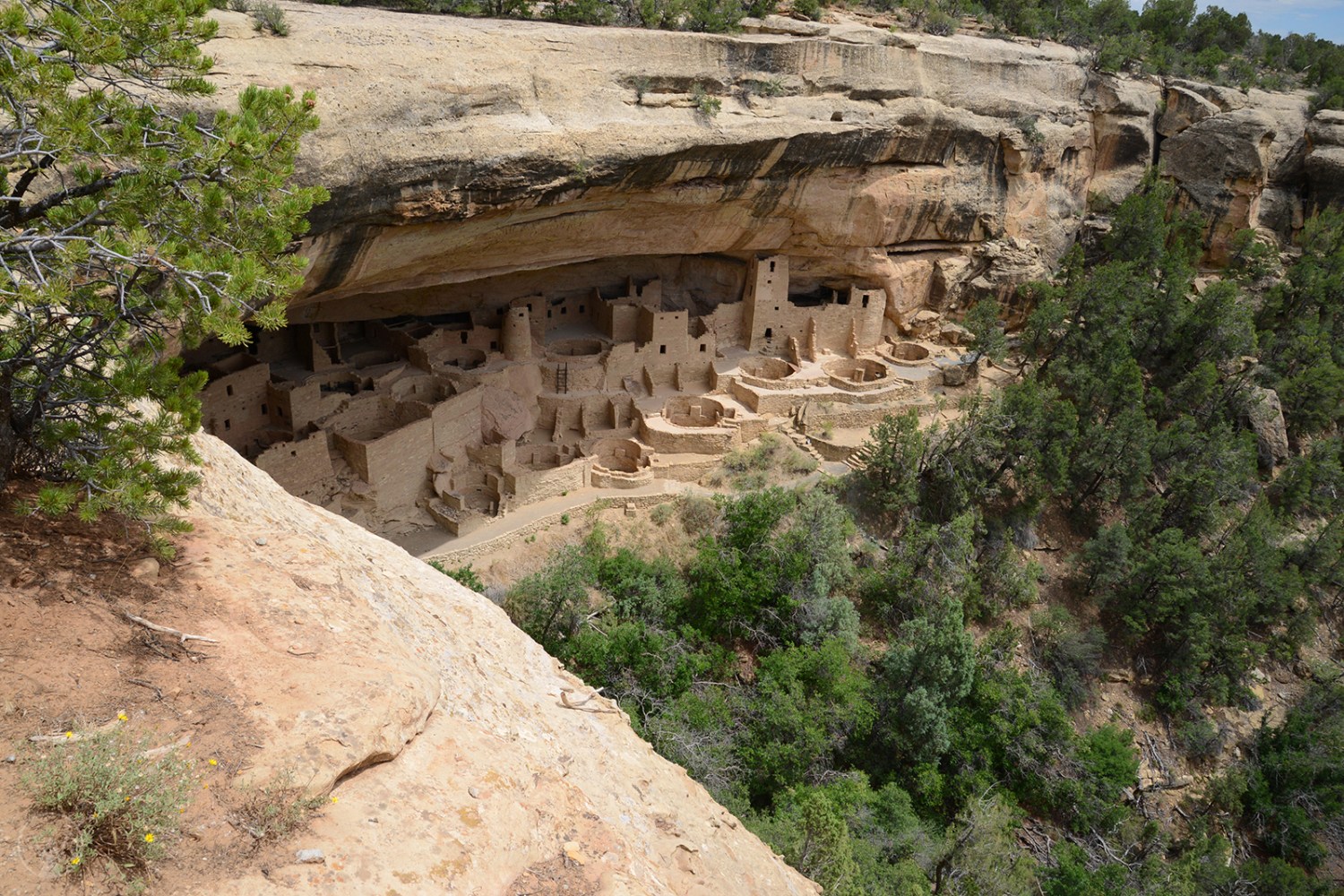
We dedicated this day entirely to Mesa Verde National Park. At our first stop we explored the various structures along the Far View Sites trails (get used to the word “kiva”) and then continued to the primary viewpoint overlooking the vast and remarkable Cliff Palace. Here and throughout the park, trails accessing the structures directly were closed, as they were generally used on ranger-guided tours (those of the Balcony House and Long House, as well as the 700 Years Tour being especially highly recommended) which were not being conducted during the pandemic. We were, nevertheless, able to enjoy completely satisfactory views of these and other structures from roadside pullouts. One path that was open was the Petroglyph Trail, which is accessed from the visitor’s center and passes the Spruce Tree House. The panel itself, while certainly worth seeing, is not as large or ornate as those, for example, at Utah’s Newspaper Rock or Nine-Mile Canyon, but the counterclockwise hike out to it was a lot of up-and-down fun through scenic terrain. (The fun factor was helped by our perfectly overcast, 80-degree weather. I can’t imagine doing this in direct sunlight at 104 degrees.) The walk back to the car along a flat, gravel path atop the mesa offered a welcome change of pace at the end of our day.
Side Excursions We Skipped
All of us had been to Four Corners at one time or another (my dad’s slides show that I was in diapers last time I sprawled simultaneously into Arizona, Colorado, New Mexico and Utah), but it’s so close to Cortez that I thought, “Why not?” Before we headed south, fortunately, the Retro Inn front desk advised us that the Why Not was, unfortunately, that due to the especially devastating COVID outbreak among the Native Americans of this region, all sites on their lands were closed to visitors. I could only imagine the impact of these closures on their economies.
NIGHT 4
Another night at the Retro Inn, but this time in the Happy Days room, which required that I tutor my boys in the ways of Arthur Fonzarelli, e.g., who The Fonz was, what “Ayyyy!” meant, why and how the finger-snap was a magic summons, etc. They wondered how he achieved any of this without Snapchat.
DAY 5
After extensive, energetic debate (see “Excursions Skipped,” below) and some logistical gambling, we decided to return to Telluride in the hopes of closing out our trip with a day of mountain biking, and thus, as a fringe benefit, completed the full Skyway by heading up 145 from Cortez. This stretch of the loop is perhaps less dramatic than the eastern side, but it struck us as more pastoral, more verdant and, therefore, more “Swiss.” Once in Telluride we were able to find great bikes at Box Canyon Bicycles and spent a memorable day on the hill. (Note that the bike park is not open every day, and I recommend reserving your bikes far in advance.) Our lift-biking experience is fairly limited — most of it occurring at Sundance — but using Deer Valley as the closest comparison, we conceded that although DV offers vastly more, and more varied, terrain, for some reason we enjoyed biking Telluride more. The homeward drive along 145, 90 and 46 through Moab was a pleasant, wind-down contrast to I-70.
Side Excursions We Skipped
I’d given some thought to the Crow Canyon Archaeology Center, but chose not to prioritize it within the context of everything else we had going on. I was very interested biking (not hiking, especially not in August) the Sand Canyon Trail at Canyon of the Ancients, but in addition to having just visited Mesa Verde, on previous trips we’d already seen the indigenous structures at sites such as Hovenweep and Recapture Canyon. And although we found bikes at Kokopelli Bike & Board in Cortez, I hadn’t brought my rack and there was no shuttle service (and we weren’t very interested in biking out to the popular Phil’s World trails north of town), and so we crossed our fingers and headed to Telluride without bike reservations, figuring that at the very least we’d ride the lift again, walk some trails and peruse main street before heading home.
Other “Too Far” Ideas I Considered in the Region
Hanging Lake, Colorado
Canyon de Chelly, Arizona (closed for COVID)
Petrified Forest, Arizona
Chaco Canyon, New Mexico
 WANDERLOOSED