


(Note: This is the first in a series of posts describing a two-week, 3,710-mile road trip going clockwise from the Boston area, up to Québec, out through the Canadian Maritimes, then back down the New England coastline. The series continues here.)
“The Cape has many layers and you need to avoid the t-shirt shops and mini golf places that ensnare most people,” a friend advised in anticipation of my trip. A life-long Bostonian, he’s as familiar with the region as one could reasonably hope to be, while his extensive travels farther afield have trained his eyes to view the familiar with objectivity and nuance. In support of my effort to avoid being ensnared, he recommended this walk to me.
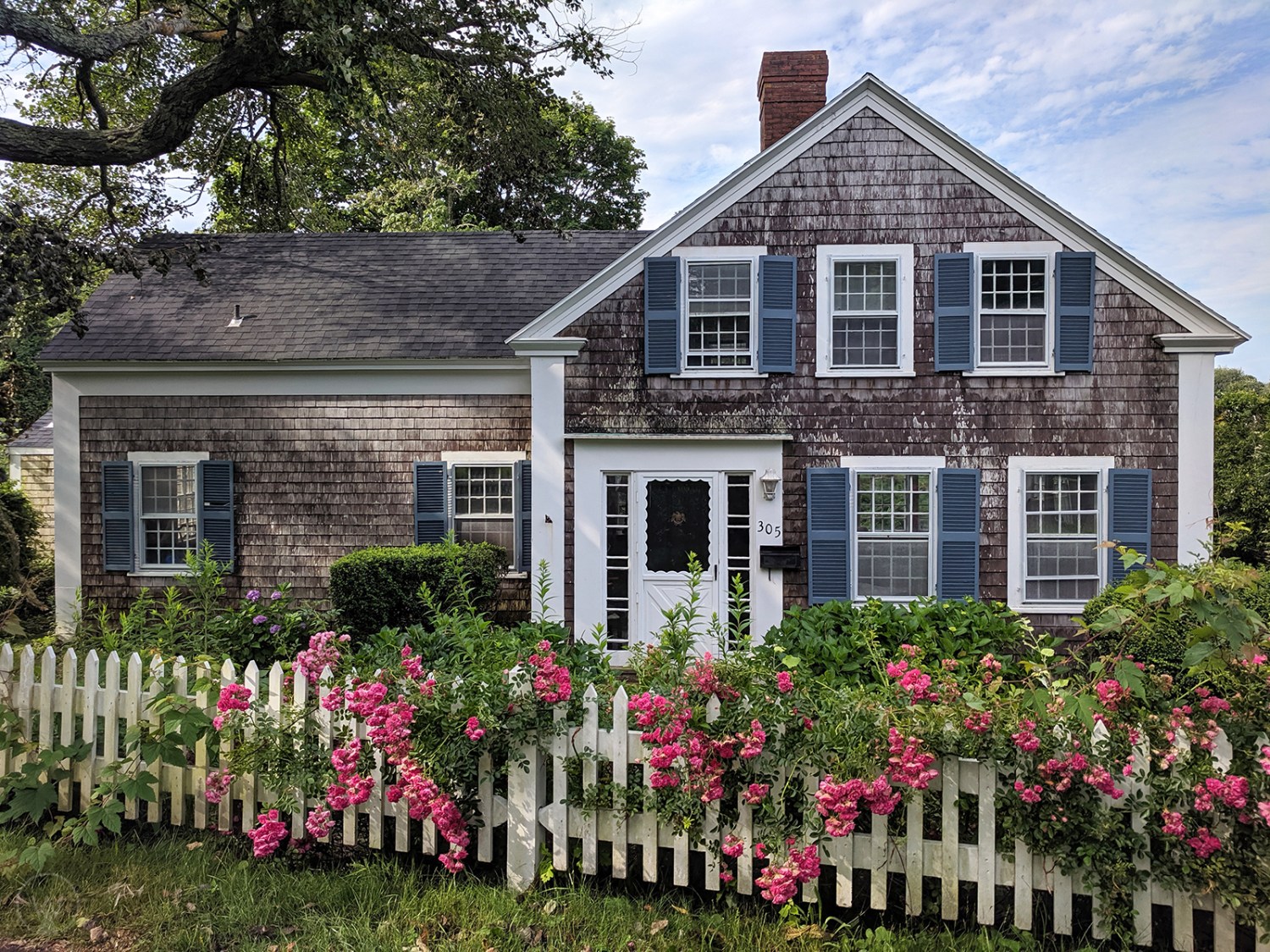
Chatham is remarkable in that the town, and this part of it in particular, could serve as the Coastal New England pavilion at Epcot, and yet it is inhabited (or “Thickly Settled,” as Cape road signs read) by actual residents going about their actual quotidian routines. This they do not altogether without perhaps a tad of conspicuous self-awareness here or a touch of fussiness there — as would probably be the case in my own neighborhood, if every other home belonged on the National Historic Register — but all of them seem quietly cognizant of their roles as caretakers of what my friend called “the Cape Cod postcard scene,” fulfilling this responsibility graciously as it falls upon them. It might have been this sense of stewardship that nudged Peter Demos, for example, discerning that I was not a paying customer, to discreetly turn on a few more lights as my shutter repeatedly broke the musty silence of his antiques shop.
My pleasure in taking this little jaunt may owe in large part to its having occurred in the early morning, my path shared only with joggers, dog-walkers, Coast Guardsmen heading out for exercises, honey bees making their first rounds, and municipal crews cleaning up after the minor tornado that had passed through town the evening before. On my return up Main Street, the shopkeepers were opening shutters and rolling racks out onto the sidewalk in anticipation of the day’s visitors. It seemed just right. At other times of day or season, the experience will likely be different, while still, I assume, entirely worthwhile. I’ll add that it was the insistence of another friend that we lodge in Chatham, rather than merely pass through town, that made the timing possible; I recommend the same.
Without stopping to shop, eat, visit the windmill or explore the beach, you’ll spend an hour and change on this route.
MAIN STREET
Park near the Orpheum Theater and, in season, your eyes will first be drawn to the hydrangeas at St. Christoper’s Episcopal Church. A few paces ahead on your left, on a small, triangular plot all its own, is a monument to local men and at least one woman, Zabina Hill, who died in the Civil War, which the monument calls “The Rebellion of 1861 – 1865.” On the corner in front of the handsome stained glass windows of the United Methodist Church is an ancient Red Jacket water pump mounted atop a stone base, with a plaque indicating that it was erected in 1914 by “The Village Improvement Club.” On your right, you can detour down toward Gristmill Lane, to see the windmill built in 1797 by Benjamin Godfrey.
Ducks in the Window sells candy and toys, featuring rubber duckies in every imaginable variety. You’ll have no trouble recognizing this shop as you pass. Buzz up for the morning on the front patio of Monomoy Coffee Co. (named after the nearby island chain mentioned below), then make someone else’s heirloom your own at Demos Antiques. Keep your eyes on the Atkins house to your left, to see if Kiera the Spanish Water Dog is standing watch from her station at the red door. There is no shortage of lace curtains adorning windows along the way, including the matched pair at 315 on your right, one of Chatham’s oldest homes, built in the early 1700s. The small “Imagine” structure (carriage house? garage? neocolonial man-cave?) at 274B on the left is your cue to turn right at Shore Road.
LIGHTHOUSE BEACH
The limeade neoclassical temple at the corner of Hallett Lane — complete with lemony Doric columns that tagged along as this entire building somehow made it past ye olde zoning committee — is the Cape Abilities Farm Market, its front lawn dominated by a massive anchor whose numerous innovations were patented in 1838 by William Porter. 158 across the street was once the residence of the family of Sumner Mayo who, judging by the Great Blue carving over the door, evidently made his living off the coast of early Chatham as a whaler. As you near the end of the road you’ll see the neighborhood opening up to the sea, with the bank rolling gently from the small parking lot down toward the sand, its crestline covered with rosehip bushes and wildflowers. Time permitting, walk the steps to the beach, which is protected from heavy surf by North Beach Island just across the narrow channel.
The obelisk on the right stands in memory to the drowned crew of a coal barge that became stranded on a nearby shoal during a storm in 1902, and to the rescue crew that perished in its attempt. The small hedged area a few yards beyond this monument is the Seamen’s Cemetery, final resting place of “the unknown sailors who lost their lives in the shipwrecks off the coast of Chatham.” Bear right past Coast Guard vessel 44301, the lighthouse and the “Danger Bar.” At the intersection you’ll see tennis courts on your left, Silver Leaf Avenue on your right, and a sign indicating that the Monomoy Island Ferry is down Bridge Street. Of the Monomoy National Wildlife Refuge, my friend writes:
Our favorite spot. Best way to get separation from the crowds with the least amount of effort. You can access via the ferry. They will drop you off and you can stay for something like 2, 4, or 6 hours. Bring food, etc. If you want to save time and not stay on the beach but still see a lot of the waterfront and seals, then you could try the Monomoy Seal Cruise. We see them out there all of the time.
Head right up Silver Leaf. On your right watch for the Monomoit Wild Salts and Sugars honor-system stand purveying hand-harvested syrups and sea salt. Wending your way along Water and School streets back toward Main, you’ll pass dozens of cedar-shingled colonial homes, many with their windows flung open to the ocean breeze, and plaques at their front doors identifying their builders or original owners.
ADDITIONAL CAPE COD TIPS
- A tour of the Woods Hole Oceanographic Institution will fascinate those interested in the astonishing technology of deep-sea exploration. (If time is tight, it’s admittedly a bit out of the way, especially for the technologically ambivalent.) Woods Hole Market and Provisions serves very good smoothies, sandwiches and chowda, and ferries to Martha’s Vineyard and Nantucket leave regularly from the nearby terminal.
- The Cape’s Atlantic-facing beaches are among the finest I’ve visited on the East Coast. Nauset, with its iconic lighthouse, is in my friend’s words “the quintessential beach on the Cape,” most scenically approached from the south via Nauset, Doane and Ocean View roads. Just up the shore, Nauset’s close cousin Marconi Beach features the nearby site of the inventor’s station from which the first transatlantic wireless communication was initiated: a Morse exchange between Teddy Roosevelt and King Edward VII. The station would later transmit instructions to the R.M.S. Carpathia to rush to the aid of the Titanic. On the more tranquil bay side, walking a mile or so out into low tide at Skaket will make an indelible memory.
- Set aside some time for your return to drive 6A rather than 6, even if you follow it only as far as Dennis or Yarmouth before returning to 6. Your investment of extra time will be repaid with views of older Cape homes, farms and mills dating as far back as the early 18th century.
- En route to or from Boston, don’t miss Plymouth just off the highway. Although underwhelming in scale (and historical precision), “The Rock” is worth a visit.
QUESTIONS FOR READERS
- Any nominations for a town that first-time visitors to Cape Cod should prioritize above Chatham?
- Where’s the best chowder on the Cape?
- What are your thoughts on Martha’s Vineyard and Nantucket?
 WANDERLOOSED
When I visit the Cape I prefer the area between Wellfleet and P-town. On our last trip we stayed very happily at Kalmar village in North Truro just south of P-town. Kalmar village had its own private stretch of beach, also we enjoyed the small unpretentious cottages. It is also quite nice that the host maintains a bonfire most every night on the dunes near the beach. You are also close enough to take the bus into P-town if you don’t want to pay for parking. P-town has such a crazy mix of shops and excellent food. On your way in or out its not a bad idea to pick up doughnuts at the Hole in One Bakery on rt 6 in Eastham. Don’t be afraid to branch out. The sour cream doughnut there was undeniably excellent.
Also if you stop in Plymouth don’t miss the Plimoth Plantation, this has all the real history that the “rock” lacks and very good exhibits maintained by local Native Americans.
LikeLike
Thank you for your helpful and detailed advice, Andrus, which complements this post in covering a different area of the Cape. A stop at any doughnut shop named “Hole in One” seems compulsory for our next visit. I hope you’re doing well!
LikeLike